


Worde: Daily & Unlimited
4.3743.00 Reviews
App Specs
- Version
- 2.1.13
- Updated On
- License
- Free
- Downloads
- 500,000+
- Developer
- ViralMedia-MLM
- Categories
- Word
- Platform
- Android
Screenshots
 Analysis by AppCompare
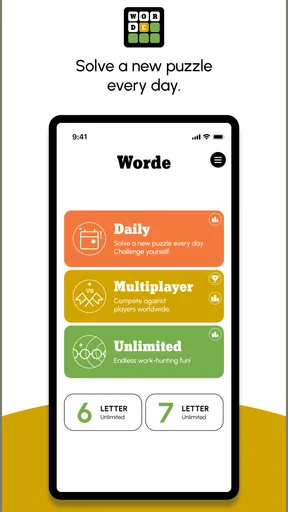
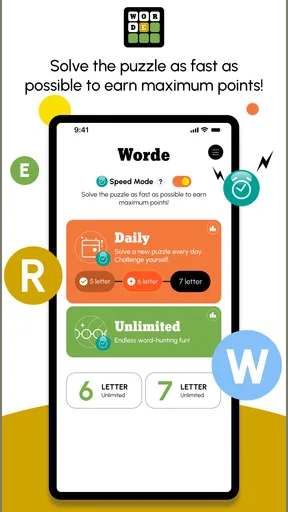
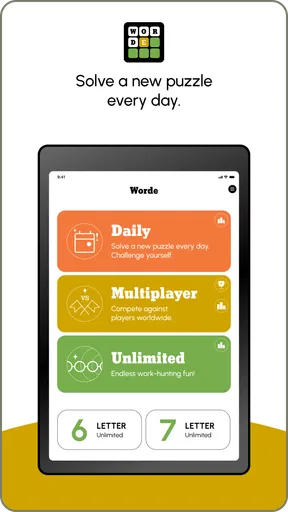
I spent time with Worde: Daily & Unlimited as a compact word game for short breaks, and its appeal became clear quickly: it gives me the familiar satisfaction of narrowing down a hidden word without requiring a long session. It is listed as a free game in the word category, with support for both six-letter and seven-letter words, daily play, unlimited rounds, and multiplayer. That combination makes it more flexible than a single-puzzle routine, although it also means the experience depends heavily on how you choose to use those modes.
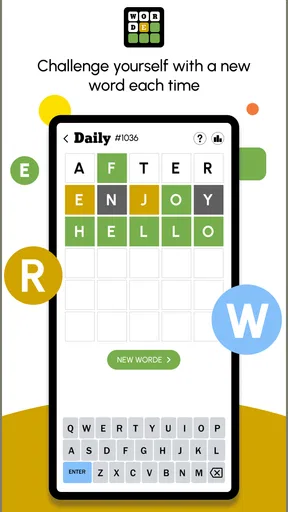
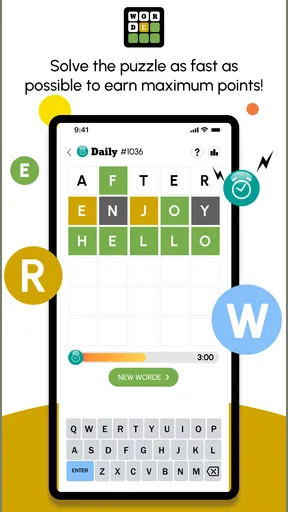
The basic loop is easy to understand. I enter a word, look at the feedback, and use each result to reduce the number of possible answers. The daily mode gives the game a natural stopping point, while unlimited play is better when I want to practice or simply keep going. Multiplayer adds a more social reason to return, especially if I enjoy comparing solving speed or discussing possible words with someone else.
What I like most is that the game does not demand a large time commitment. I can play one round while waiting for a train, use several unlimited attempts as a mental warm-up, or return later to work through a difficult puzzle. Its strongest quality is the choice between a measured daily habit and open-ended practice. That flexibility is more useful than it may sound, because word games can feel repetitive when they offer only one fixed rhythm.
How I use the daily and unlimited modes
My normal starting point is the daily mode. I treat it as a small language exercise rather than something to rush through. The first guess is important, but I try not to waste it on an obscure word. A word with several different vowels and common consonants gives me more information than a narrowly chosen answer, even when it does not happen to be the solution.
After that first attempt, I separate confirmed letters from possible letters. I also keep track of positions that have already failed. This sounds obvious, but it is where many mistakes happen: finding the right letters is not enough if I repeatedly place them in locations that the board has already ruled out. Worde rewards careful elimination more than random vocabulary knowledge.
The daily format works well for people who want a predictable habit. I can play once, think about the result, and stop without feeling that I have left a larger challenge unfinished. It is also a good choice for families or friends who want to compare their approaches without turning the game into a long competition.
Unlimited mode changes my behavior. Instead of protecting one attempt, I use it as a training space. I deliberately test different opening words, pay attention to repeated-letter situations, and practice solving when the first few clues are unhelpful. This is one of the less obvious strengths of having both modes: unlimited play can improve the quality of my daily guesses if I use it intentionally rather than simply replaying rounds without reflection.
Worth Reading Before You Choose

EA SPORTS FC Mobile 26 Is a Bigger Football Game, but It Takes Time

Flipboard Shows What News Apps Must Do Beyond the Feed

Switching to Android Auto Means Rethinking Your Driving Routine

Google Calendar Makes a Crowded Week Easier to Manage

Ludo King Makes the Most of the Minutes Between Plans

Baby Panda World Brings Quick Play to Modern Phones, but Its Game Library Feels Busy
The six-letter and seven-letter options also create a meaningful difference in difficulty. A seven-letter puzzle gives me more room for possible combinations, so I need to manage the board more methodically. It is not merely a longer version of the shorter mode; the extra letters make early information more valuable and make careless guesses more expensive.
For a realistic everyday routine, I would use the daily puzzle with breakfast, then reserve unlimited rounds for a commute or an evening break. If I am playing with another person, multiplayer is a better fit than passing one device back and forth, because the competitive element gives each round a clearer purpose. I would not use the game as a substitute for a full vocabulary course, but it is a pleasant way to make word recognition and deduction part of a normal day.
Settings and habits that make a difference
I recommend checking the available in-game options before settling into a routine. The useful principle is simple: choose settings that make the feedback easy to read and the pace comfortable, rather than changing options constantly in search of an advantage. A word puzzle is most enjoyable when I can concentrate on deduction instead of fighting the interface.
I also pay attention to whether I am playing for practice, relaxation, or competition. For practice, I want to slow down and examine every clue. For relaxation, I accept that some rounds will take longer and avoid treating an unsuccessful guess as a failure. In multiplayer, I focus more on consistency than on one fast solution. Mixing these goals in the same session can make the game feel uneven, so deciding my purpose first helps.
Because the game is free to download, it is easy to try without a financial commitment. It does include optional in-app purchases ranging from forty-nine cents to forty-five dollars and forty-four cents per item, so I would still check the purchase flow carefully if a child uses the device or if I prefer a completely interruption-free experience. The Everyone age rating makes it approachable for a broad audience, but an age label does not replace sensible device controls.
One practical habit is to keep a small mental distinction between “known,” “possible,” and “discarded.” Known letters belong in fixed positions. Possible letters have appeared but still need placement. Discarded letters should not return to later guesses unless the feedback specifically suggests a repeated-letter complication. This three-part approach is more reliable than trying to remember the entire board as one visual pattern.
Another useful adjustment is to avoid changing the way I interpret clues halfway through a round. If I start by treating the puzzle as a process of elimination, I should continue doing that even when I recognize a likely answer. Guessing too early can throw away a turn, particularly in the seven-letter mode. The game is more forgiving when I use the board as evidence instead of relying on a hunch.
Faster solving without careless guessing
Experienced play is less about knowing rare words and more about extracting several kinds of information from one attempt. I look for guesses that test unconfirmed vowels, introduce common consonants, and avoid repeating letters unless repetition itself is the question I need to investigate. This makes each turn serve a purpose.
When I have several confirmed letters, I stop searching for a perfect guess in my head and begin listing realistic patterns. For example, I mentally compare possible endings, common letter pairs, and familiar word shapes. This is faster than cycling through random words, and it reduces the temptation to enter a word simply because it “looks right.”
Repeated letters are a particular source of friction. A correct letter does not always tell me how many times it occurs, so I treat a duplicate as a deliberate test rather than an automatic assumption. If the board suggests that a letter may appear twice, using it again can reveal more than introducing an unrelated letter. The trade-off is that I may learn less about the rest of the alphabet on that turn, which is why I reserve this tactic for situations where the pattern already points in that direction.
The seven-letter mode makes this decision-making more important. With additional positions, I can easily become attached to a partial pattern and overlook another plausible arrangement. I find it helpful to read the entire row from left to right after each guess, then review the unused letters separately. That short pause prevents me from focusing only on the most visually obvious clue.
Unlimited play is especially valuable here because it lets me test a repeatable opening strategy. I can use one broad first word for several rounds, notice where it gives weak information, and then adjust. I would not claim that one starting word is universally best; its value depends on whether I prefer testing vowels, common consonants, or a balanced mixture. The important point is to compare my own results and comfort rather than copying a supposed perfect opener.
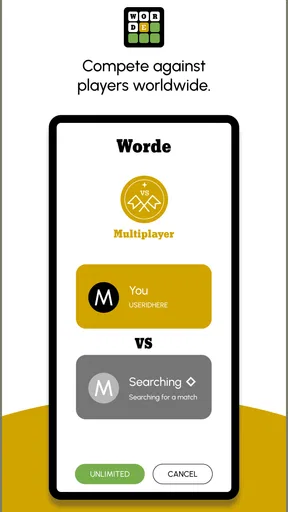
For multiplayer, speed should not replace accuracy. A quick guess that reveals little can leave me behind later, while a thoughtful opening can create a stronger position even if it takes a few extra seconds. If the other player enjoys pressure and rapid turns, the mode can feel energetic. If they prefer calm word solving, the daily mode may be the better shared experience.
Where the game reaches its limits
Worde: Daily & Unlimited is not the right choice for everyone. If I want a deep campaign, character progression, a story, or a constantly changing set of puzzle mechanics, this game will feel intentionally narrow. Its pleasure comes from the word grid and the reasoning around it, not from a larger game world.
It may also disappoint players who want a highly instructional vocabulary tool. Solving a word can expose me to unfamiliar spelling patterns, but the core activity is deduction. I should not expect detailed definitions, structured lessons, or a guided language curriculum simply because the game uses words. Someone learning a language may find it useful as light practice, but a dedicated language-learning app would provide more explanation and progression.
The free model is convenient, yet optional purchases mean that users who prefer a strictly paid-once or entirely purchase-free environment should review the experience before committing to regular play. I also think the broad age rating makes the game accessible, but younger players may need help understanding why a guess is strategically useful rather than merely choosing words they know.
The public reception suggests that the game has found a substantial audience: it has an average rating of 4.3 from around eleven thousand ratings and more than five hundred thousand installs. Those figures make it easier for me to regard the app as an established option rather than an untested novelty, but they do not remove the personal question of whether its word selection, interface, and pacing suit me.
It is maintained by ViralMedia-MLM, and the current version is 2.1.13. The game runs on Android 7.0 or later, which covers older devices as well as newer ones. That is helpful if I want to install it on a spare phone or share it with someone who does not use the latest hardware. Still, device compatibility alone does not guarantee that every player will enjoy the same pace or presentation.
Compared with the usual single-daily-puzzle alternatives, the main advantage here is freedom. I can preserve a daily ritual, practice repeatedly, or move into multiplayer instead of being limited to one round. Compared with larger word-game collections, the advantage is focus: I do not have to learn several unrelated rule sets. The trade-off is variety. If I need anagrams, crosswords, spelling lessons, and trivia in one place, a broader collection would probably suit me better.
Who should install it
I would recommend this game to someone who enjoys deduction, likes testing vocabulary through patterns, and wants a word puzzle that can fit around ordinary routines. It is particularly suitable for players who appreciate having both six-letter and seven-letter challenges, because the longer format gives experienced solvers a more demanding option without abandoning the familiar structure.
It is also a good match for friends who want a light competitive activity. Multiplayer gives the basic word-solving loop a reason to repeat, while daily mode is better for people who prefer a quiet personal challenge. Unlimited mode makes the app more useful for practice than a strictly once-a-day alternative, especially if I am trying to improve my opening guesses or become more comfortable with repeated letters.
I would suggest skipping it if I need extensive explanations, a rich progression system, or a large range of puzzle types. I would also skip it if I know that unlimited retries make word games feel endless rather than enjoyable. In that case, a single daily puzzle may be more satisfying, or a different word game with a clear campaign could provide a stronger sense of progress.
One final practical question is whether the app is suitable for casual family use. The Everyone rating and straightforward rules make that possible, and the modes offer different ways to play together. I would still explain the purchase settings before handing over a device, and I would choose daily or multiplayer depending on whether the group wants cooperation, comparison, or simply a shared conversation about possible words.
My verdict after building a routine
After using the different modes as separate tools, I see Worde: Daily & Unlimited as more than a basic daily clone, but not as a complete word-game universe. Its best design decision is the split between a controlled daily challenge and unlimited practice. That lets me decide whether I want a small habit, a longer session, or a competitive round without installing several similar games.
My preferred routine is to make one careful daily attempt, then use unlimited play only when I have a specific goal: testing an opening word, practicing seven-letter patterns, or working on repeated-letter situations. That approach keeps the game from becoming mindless and makes each extra round useful. I also find that reviewing why a guess failed teaches me more than immediately starting another puzzle.
The limitations are straightforward. Players looking for richer content, formal vocabulary teaching, or extensive variety should look elsewhere. The optional purchase range deserves attention, and the core loop may become repetitive for anyone who does not enjoy word deduction on its own. Those are not minor details; they determine whether the app remains enjoyable after the first few sessions.
For me, the balance is favorable. The game is free, accessible to a wide age range, available on older Android versions, and flexible enough to support both solitary practice and multiplayer competition. I recommend it as a focused word puzzle for people who value repeatable habits over elaborate extras. If that describes you, the daily mode gives you a clean starting point, while unlimited and seven-letter play provide enough room to keep sharpening your approach.
Pros
- Daily mode offers a quick
- focused word puzzle for short play sessions.
- Unlimited mode lets dedicated players continue solving beyond the daily challenge.
- Simple controls make the game easy to learn without a lengthy tutorial.
- Color feedback helps players refine guesses and build solving strategies.
- Works well as a casual brain-training activity during spare moments.
Cons
- Some puzzles may feel repetitive for experienced daily word-game players.
- The difficulty can vary noticeably between different puzzles.
- Players who dislike word games may find the gameplay quickly becomes routine.
- Hints or assistance may reduce the satisfaction of solving unaided.
- A stable internet connection may be needed for some features or updates.
FAQs for Worde: Daily & Unlimited
What is Worde: Daily & Unlimited?
Worde: Daily & Unlimited is a word puzzle game built around guessing a hidden word within a limited number of attempts. It offers a daily challenge for players who enjoy solving the same puzzle each day, along with unlimited gameplay for those who want to continue playing. The simple format is easy to understand, but finding the correct word can become increasingly challenging.
How does the gameplay in Worde: Daily & Unlimited work?
Each round asks you to discover a target word by entering possible guesses. After every attempt, the game provides visual clues showing which letters are correct, misplaced, or not included in the answer. You use this feedback to narrow down the possibilities and solve the puzzle before running out of guesses. The mechanics are straightforward, although vocabulary and deduction skills are important.
Does Worde: Daily & Unlimited include a daily mode and unlimited puzzles?
Yes, the app is designed to support both a daily puzzle experience and unlimited play. The daily mode gives you a single challenge to complete and is suitable for comparing results or maintaining a regular routine. Unlimited mode allows you to start additional rounds whenever you like, making the game more appropriate for longer sessions and repeated practice.
Can I play Worde: Daily & Unlimited without an internet connection?
Some features may work without a continuous internet connection, particularly if the necessary game content has already been loaded on your device. However, online access may be needed for updates, daily puzzle synchronization, advertisements, statistics, or other connected features. Offline behavior can vary depending on the version and device, so it is best to open the app online before relying on it without connectivity.
Is Worde: Daily & Unlimited free to download and suitable for all players?
Worde: Daily & Unlimited can generally be downloaded at no initial cost, but the exact experience may include advertising, optional purchases, or other platform-dependent limitations. It is suitable for casual players, word-game fans, and anyone looking for a short daily brain exercise. Before downloading, check the store listing for the current age rating, permissions, privacy details, and in-app purchase information.


